Definition
Primary succession is the orderly and predictable series of events through which a stable ecosystem forms in a previously uninhabited region. Primary succession occurs in regions characterized by the absence of soil and living organisms.
Primary Succession Overview
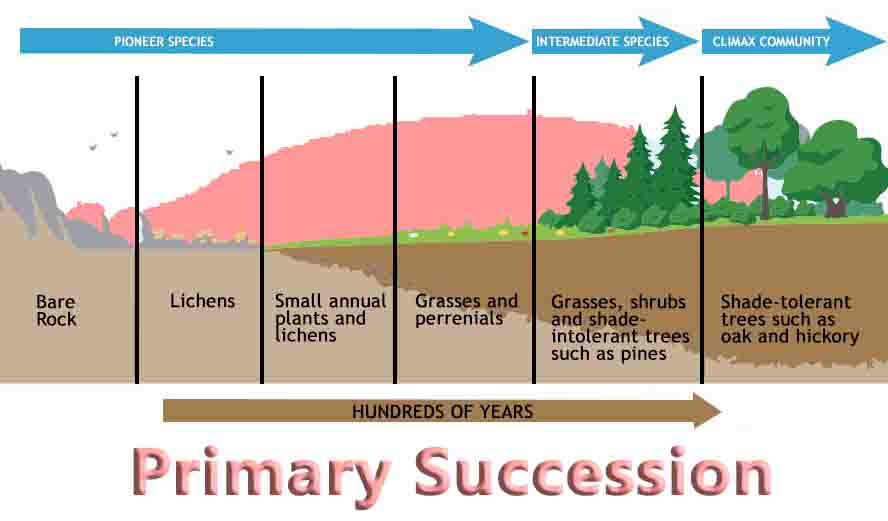
Primary succession begins with the appearance of pioneer species – lichen, mosses, and fungi – all organisms that can grow on rocks and exposed land. These are small, simple organisms that can survive harsh conditions, fix inorganic carbon and nitrogen into usable nutrients and accelerate the process of weathering.
As these organisms die and decompose, their organic matter becomes the foundation for a thin layer of soil. Pioneer species pave the way for more complex communities of organisms because the pioneers have altered the physical environment to make it more habitable. This leads to other forms of ecological succession.
Once grasses and weeds begin to grow, soil formation is accelerated and more animal species begin to appear. The environment retains moisture, and ideal conditions are created for the growth of shrubs and small trees. This is followed by larger trees and animals, and the complex web of interactions between them.
Primary Succession vs Secondary Succession
There are several differences between primary and secondary succession. With primary succession, there are no available nutrients for advanced plant life to use. This typically only happens when there is no soil or the soil that was present before a disturbance is completely sterilized. This means that organisms must completely start the process of succession over.
By contrast, secondary succession can happen after a disturbance that does not completely eliminate the microbes present in the soil that help make nutrients available to plants. Secondary succession can happen much faster than primary succession because the basis for advanced plant life is already in place. For example, after a mild forest fire, a forest can rapidly regenerate through secondary succession.
Secondary succession occurs after an event that deeply disturbs an existing, stable ecosystem when most above-ground vegetation and living organisms disappear from the region. Though it appears as if the region is ‘dead’, the soil remains fertile and contains enough organic matter to support the reappearance of life. Grasses are among the first species to appear, quickly followed by shrubs and small trees.
The major difference between primary and secondary succession is the quality of the soil. Secondary succession does not require pedogenesis or soil formation. For example, primary succession would occur on barren land that was previously covered by a glacier, while secondary succession would occur on land after a forest fire.
The forest fire may destroy all the plants and drive away the animals, but the ashes and decomposing organic matter can enrich the soil, and life restarts from sprouting roots and shoots and through the germination of seeds already present in the soil. In the case of the retreating glacier, however, the land has not supported life for hundreds of thousands of years and lacks any organic matter.
It should also be noted that seasonal and cyclical succession are also types of ecological succession that can lead to different compositions of species in an ecosystem over time. These forms of succession are based on changes in available nutrients, water, and other resources over time.
Examples of Primary Succession
Primary succession can occur after a variety of events. These include:
- Volcanic eruptions
- Retreat of glaciers
- Flooding accompanied by severe soil erosion
- Landslides
- Nuclear explosions
- Oil spills
- Abandonment of a manmade structure, such as a paved parking lot
While some of these are natural events, some are anthropogenic, or manmade.
After a Volcanic Eruption
Lava from an erupting volcano incinerates everything in its path and forms new land that is made from inorganic material. While it is rich in minerals, the land cannot support a varied and complex ecosystem. Its capacity to sustain a stable ecosystem is limited. Pioneer species that colonize areas after volcanic eruptions include sword fern and green algae.
A few small invertebrate animals may also venture into this territory, followed by crickets and spiders. Eventually, these forms of life will create new niches in the environment that can support greater biodiversity.
In the case of volcanic eruptions in the ocean, the atolls formed are isolated from other terrestrial ecosystems and have unique food chains and webs. Pioneer species often arise from spores carried through ocean currents or blow to these new islands on the wind. Isolated islands often have unique ecosystems simply due to the random chance that has carried specific species to the new landmass.
In Sand Dunes
Seashores are harsh environments because of high wind speeds, moving sand, and the minimal availability of freshwater and organic nutrients. Pioneer plants in such environments tend to have symbiotic bacteria in their root nodules to fix nitrogen. They have root systems that can anchor them in shifting sand and multiple other adaptations to harvest freshwater. Many of them also have adaptations to reduce water loss through transpiration. Examples of pioneer species in sand dunes include sand couch grass and lyme grass.
These species are followed by other grasses, and then by lichens that are deposited on the thin layer of organic matter created by the pioneer species. As the ecosystem develops, bracken, gorse, heather, hawthorn, and brambles can be seen.
Eventually, a woodland will develop, containing organisms that can thrive in a high salt environment.
After a Nuclear Explosion
Some islands in French Polynesia were used for extensive testing of nuclear bombs in the 1960s and 70s. They were completely denuded of all plant, animal, and microbial life. Scientists estimated that it would take centuries before life returned to these islands. However, surveys conducted over the course of 30 years show that primary succession has begun, and many islands have grasses, mosses, and some plants. Some species of mollusks have also begun to live on these islands.
After the major accident at Chernobyl Nuclear Reactor in Ukraine (1986), the area was evacuated and has had minimal human habitation for the past three decades. The central reactor is still highly radioactive and is considered a complete ‘dead’ zone. However, robots sent into the heart of this reactor returned with black fungi that were using the radiation itself as an energy source.
FAQ’s
What is primary succession?
Primary succession is the process of ecological succession that occurs in an area that has not been previously colonized by living organisms. This can occur in areas such as newly formed volcanic islands or areas that have been scraped clean by glaciers.
What are the stages of primary succession?
The stages of primary succession typically include the colonization of the area by pioneer species such as lichens and mosses, followed by the establishment of grasses, shrubs, and eventually, trees. Over time, the soil develops and becomes more complex, allowing for the growth of larger and more diverse plant species.
How long does primary succession take?
The length of time required for primary succession to occur can vary widely depending on factors such as climate, soil conditions, and the presence of nearby seed sources. In some cases, it can take hundreds or even thousands of years for a mature ecosystem to develop.
What are some examples of primary succession?
Some examples of primary succession include the colonization of bare rock by lichens and mosses, the formation of sand dunes, and the growth of plants on newly exposed volcanic terrain.
What is the significance of primary succession?
Primary succession plays an important role in the formation and evolution of ecosystems. By studying the process of primary succession, scientists can gain insights into the ways in which species interact with their environment and the mechanisms by which ecological communities develop and change over time. Additionally, primary succession can have practical implications for ecological restoration efforts in areas that have been disturbed or degraded by human activities.