Category: Education

  • Lytic Cycle

    Lytic Cycle Definition

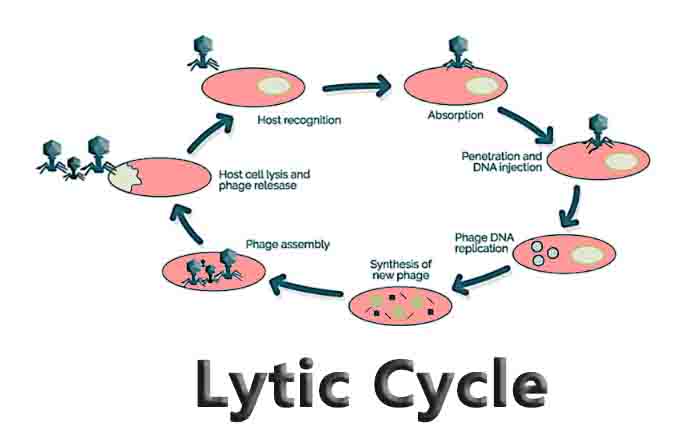
    The lytic cycle is named for the process of lysis, which occurs when a virus has infected a cell, replicated new virus particles, and bursts through the cell membrane. This releases the new virions, or virus complexes, so they can infect more cells.

    The lytic cycle is often accompanied by the lysogenic cycle in many bacteria viruses, known as bacteriophages. After the virus injects its DNA or RNA into the host bacteria, the genetic material can enter either the lytic cycle or the lysogenic cycle.
    In the lysogenic cycle, the bacteriophage DNA lies practically dormant. However, whenever the bacteria divides, the DNA of the virus is inadvertently copied. In this way, the virus can continue replicating within its host. As long as the bacteria are successful, the virus may remain dormant. At a certain point, conditions may change, and the virus will enter the lytic cycle.

    In this cycle, the viral DNA or RNA is expressed by the host organism’s cellular mechanisms. In other words, the viral genes use the proteins within the cell to replicate themselves and produce viral proteins. These proteins and copies of the DNA will become new virions. The cell, helpless to its viral hijacker, simply waits until the pressure of these new virions is too high. Then, the cell membrane breaks.

    This lysis of the cell releases the virions created in the lytic cycle. Their final destination is a new cell, in which the lytic cycle can take place again. If conditions are favorable and the cell is dividing, the virus may stay in the lysogenic cycle for a time. Ultimately, to infect a greater number of cells, more virus genomes will enter the lytic cycle and produce thousands or millions of copies of themselves in a shorter amount of time.

    Steps of the Lytic Cycle

    Adsorption and Penetration

    Adsorption is the process through which a bacteria gets its DNA or RNA into the host cell. This is labeled as 1 in the image above. The capsid, or protein coat around the viral genome, consists of very specific proteins.

    This sheild of proteins not only comes together to protect the viral genes, it serves as a sort of “key” to unlock a cell. The surface of the proteins are shaped to interact with proteins on the surface of the host cell.

    When the “lock and key” align, the virion is bound to the cell membrane. When this happens, it also changes the shape of the capsid. This tears a hole or injects the viral DNA into the host cell. Here, it may travel into the nucleus or replicate in the cytoplasm. This depends on the virus itself, what type of genome it has, and the conditions of the cell.

    Replication

    During the lytic cycle, the replication of viral genes is carried out a number of times by a hijacked cellular system. Remember that the virus itself has imported few, if any, supporting proteins. Thus, the viral DNA must produce these in order to hijack the cell’s processes.

    The first proteins created are often created as the cell reads its own DNA and produces proteins. The viral genes simply sneak into the process. This creates what are called viral early proteins.

    These early proteins have important functions (to the virus) of commandeering the cell’s machinery. They clear the cell’s normal metabolic agenda, and turn many of its activities toward the replication of viral genes and the production of viral proteins. The virus uses the raw products the cell has assembled (amino acids and nucleic acids) as building blocks for the parts it needs.

    While this may seem like an overly complex process for such a small virus genome, consider first that there are really only a handful of proteins. Most viruses produce and code for only a handful of proteins.

    Unlike cells, a virus doesn’t need the complex proteins required to metabolize energy. As obligate parasites, a virus is dependent upon its host cell’s ability to provide raw materials. This makes it one of the most efficient forms of DNA replication that we know of.

    Assembly and Release

    As these parts are built, their natural evolutionary shapes help them come together in the proper way. Since most of the components are proteins, they have formed over evolutionary time to be able to come together with very little outside influence. The assembly of new virions is a hallmark of the lytic cycle. The other viral life cycle does not include producing and assembling new virions.

    In this way, the lytic cycle resembles a small virus factory. All of the parts of the virus are produced independently, then assembled, and finally released into the environment. While the image above shows only 3 assembled virions at stage 6, in reality there would be millions. Compare the lytic cycle to the lysogenic cycle below it, in which an accurate 2 copies are shown after 1 bacterial division.

    FAQ’s

    What is the lytic cycle?

    The lytic cycle is a process of viral replication in which a virus enters a host cell, hijacks the host’s cellular machinery to replicate its own genetic material, and ultimately causes the host cell to burst, releasing new viral particles that can infect other cells.

    How does the lytic cycle differ from the lysogenic cycle?

    The main difference between the lytic and lysogenic cycles is that in the lytic cycle, the viral DNA or RNA immediately takes over the host cell’s machinery and replicates itself, while in the lysogenic cycle, the viral DNA or RNA is integrated into the host cell’s DNA and may remain dormant for some time before activating.

    What are the stages of the lytic cycle?

    The lytic cycle consists of several stages, including attachment, penetration, biosynthesis, maturation, and release. During attachment, the virus attaches to a host cell. In penetration, the virus injects its genetic material into the host cell. In biosynthesis, the viral genetic material replicates, and new viral particles are produced. In maturation, the viral particles assemble and mature. In release, the host cell bursts, and new viral particles are released into the environment to infect other cells.

    What are some examples of viruses that use the lytic cycle?

    Some examples of viruses that use the lytic cycle include the influenza virus, the herpes simplex virus, and the human immunodeficiency virus (HIV).

    What is the significance of the lytic cycle in viral infections?

    The lytic cycle is a key mechanism by which viruses replicate and spread from host to host. Understanding the molecular mechanisms of the lytic cycle is important for developing treatments and vaccines to combat viral infections.
  • Primary Succession

    Definition

    Primary succession is the orderly and predictable series of events through which a stable ecosystem forms in a previously uninhabited region. Primary succession occurs in regions characterized by the absence of soil and living organisms.

    Primary Succession Overview

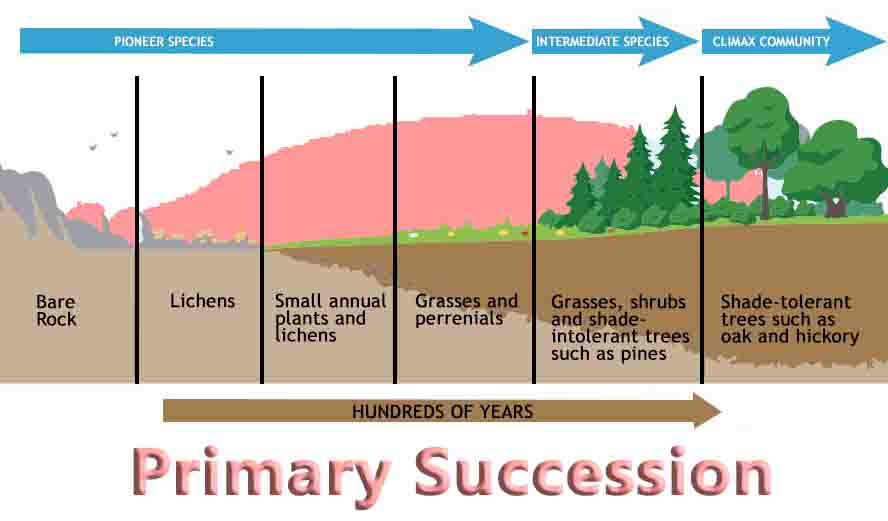
    Primary succession begins with the appearance of pioneer species – lichen, mosses, and fungi – all organisms that can grow on rocks and exposed land. These are small, simple organisms that can survive harsh conditions, fix inorganic carbon and nitrogen into usable nutrients and accelerate the process of weathering.

    As these organisms die and decompose, their organic matter becomes the foundation for a thin layer of soil. Pioneer species pave the way for more complex communities of organisms because the pioneers have altered the physical environment to make it more habitable. This leads to other forms of ecological succession.

    Once grasses and weeds begin to grow, soil formation is accelerated and more animal species begin to appear. The environment retains moisture, and ideal conditions are created for the growth of shrubs and small trees. This is followed by larger trees and animals, and the complex web of interactions between them.

    Primary Succession vs Secondary Succession

    There are several differences between primary and secondary succession. With primary succession, there are no available nutrients for advanced plant life to use. This typically only happens when there is no soil or the soil that was present before a disturbance is completely sterilized. This means that organisms must completely start the process of succession over.

    By contrast, secondary succession can happen after a disturbance that does not completely eliminate the microbes present in the soil that help make nutrients available to plants. Secondary succession can happen much faster than primary succession because the basis for advanced plant life is already in place. For example, after a mild forest fire, a forest can rapidly regenerate through secondary succession.

    Secondary succession occurs after an event that deeply disturbs an existing, stable ecosystem when most above-ground vegetation and living organisms disappear from the region. Though it appears as if the region is ‘dead’, the soil remains fertile and contains enough organic matter to support the reappearance of life. Grasses are among the first species to appear, quickly followed by shrubs and small trees.

    The major difference between primary and secondary succession is the quality of the soil. Secondary succession does not require pedogenesis or soil formation. For example, primary succession would occur on barren land that was previously covered by a glacier, while secondary succession would occur on land after a forest fire.

    The forest fire may destroy all the plants and drive away the animals, but the ashes and decomposing organic matter can enrich the soil, and life restarts from sprouting roots and shoots and through the germination of seeds already present in the soil. In the case of the retreating glacier, however, the land has not supported life for hundreds of thousands of years and lacks any organic matter.

    It should also be noted that seasonal and cyclical succession are also types of ecological succession that can lead to different compositions of species in an ecosystem over time. These forms of succession are based on changes in available nutrients, water, and other resources over time.

    Examples of Primary Succession

    Primary succession can occur after a variety of events. These include:

    • Volcanic eruptions
    • Retreat of glaciers
    • Flooding accompanied by severe soil erosion
    • Landslides
    • Nuclear explosions
    • Oil spills
    • Abandonment of a manmade structure, such as a paved parking lot

    While some of these are natural events, some are anthropogenic, or manmade.

    After a Volcanic Eruption

    Lava from an erupting volcano incinerates everything in its path and forms new land that is made from inorganic material. While it is rich in minerals, the land cannot support a varied and complex ecosystem. Its capacity to sustain a stable ecosystem is limited. Pioneer species that colonize areas after volcanic eruptions include sword fern and green algae.

    A few small invertebrate animals may also venture into this territory, followed by crickets and spiders. Eventually, these forms of life will create new niches in the environment that can support greater biodiversity.

    In the case of volcanic eruptions in the ocean, the atolls formed are isolated from other terrestrial ecosystems and have unique food chains and webs. Pioneer species often arise from spores carried through ocean currents or blow to these new islands on the wind. Isolated islands often have unique ecosystems simply due to the random chance that has carried specific species to the new landmass.

    In Sand Dunes

    Seashores are harsh environments because of high wind speeds, moving sand, and the minimal availability of freshwater and organic nutrients. Pioneer plants in such environments tend to have symbiotic bacteria in their root nodules to fix nitrogen. They have root systems that can anchor them in shifting sand and multiple other adaptations to harvest freshwater. Many of them also have adaptations to reduce water loss through transpiration. Examples of pioneer species in sand dunes include sand couch grass and lyme grass.

    These species are followed by other grasses, and then by lichens that are deposited on the thin layer of organic matter created by the pioneer species. As the ecosystem develops, bracken, gorse, heather, hawthorn, and brambles can be seen.

    Eventually, a woodland will develop, containing organisms that can thrive in a high salt environment.

    After a Nuclear Explosion

    Some islands in French Polynesia were used for extensive testing of nuclear bombs in the 1960s and 70s. They were completely denuded of all plant, animal, and microbial life. Scientists estimated that it would take centuries before life returned to these islands. However, surveys conducted over the course of 30 years show that primary succession has begun, and many islands have grasses, mosses, and some plants. Some species of mollusks have also begun to live on these islands.

    After the major accident at Chernobyl Nuclear Reactor in Ukraine (1986), the area was evacuated and has had minimal human habitation for the past three decades. The central reactor is still highly radioactive and is considered a complete ‘dead’ zone. However, robots sent into the heart of this reactor returned with black fungi that were using the radiation itself as an energy source.

    FAQ’s

    What is primary succession?

    Primary succession is the process of ecological succession that occurs in an area that has not been previously colonized by living organisms. This can occur in areas such as newly formed volcanic islands or areas that have been scraped clean by glaciers.

    What are the stages of primary succession?

    The stages of primary succession typically include the colonization of the area by pioneer species such as lichens and mosses, followed by the establishment of grasses, shrubs, and eventually, trees. Over time, the soil develops and becomes more complex, allowing for the growth of larger and more diverse plant species.

    How long does primary succession take?

    The length of time required for primary succession to occur can vary widely depending on factors such as climate, soil conditions, and the presence of nearby seed sources. In some cases, it can take hundreds or even thousands of years for a mature ecosystem to develop.

    What are some examples of primary succession?

    Some examples of primary succession include the colonization of bare rock by lichens and mosses, the formation of sand dunes, and the growth of plants on newly exposed volcanic terrain.

    What is the significance of primary succession?

    Primary succession plays an important role in the formation and evolution of ecosystems. By studying the process of primary succession, scientists can gain insights into the ways in which species interact with their environment and the mechanisms by which ecological communities develop and change over time. Additionally, primary succession can have practical implications for ecological restoration efforts in areas that have been disturbed or degraded by human activities.

  • Synapomorphy

    Synapomorphy Definition

    A synapomorphy is a shared, derived character, common between an ancestor and its descendants. A character, or trait, is anything observable about the organism. It may be the size of the organism, the type of skin covering the organism has, or even things like eye color.

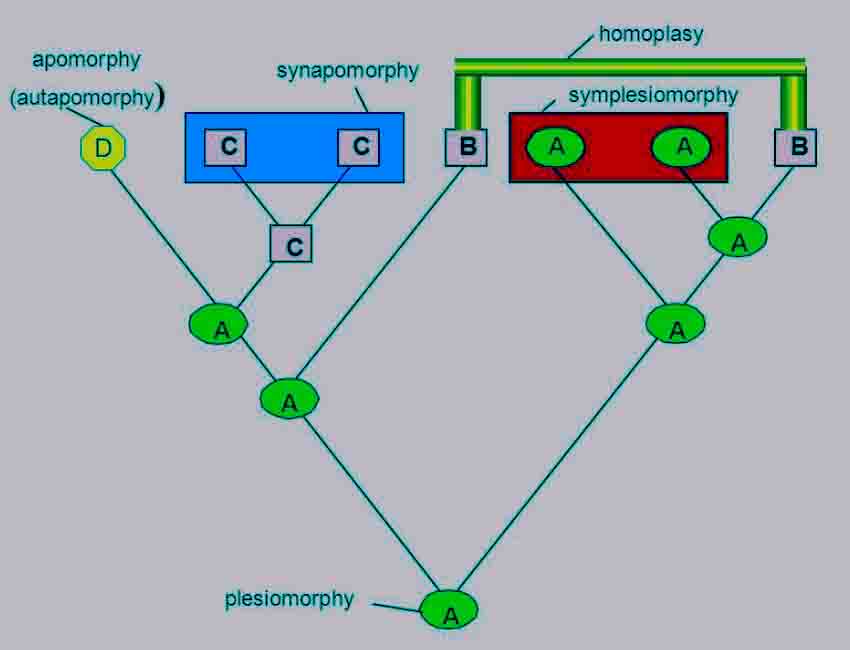
    A character may also be considered a specific sequence of DNA, which is how modern phylogenetic trees are constructed. As seen in the image below, a synapomorphy could be any characteristic shared by the descendants of a common ancestor.

    In fact, the term synapomorphy comes from the Greek “syn” meaning shared, “apo” meaning away from, and “morphe” meaning form or shape. In other words, the animals have a shared form as they move away from their ancestors and related animals.

    A synapomorphy can help scientists determine which groups of animals are related, and which aren’t. Animals which share a synapomorphy likely share a common ancestor. If groups of organisms share more than one synapomorphy, there is even more evidence that they are related.

    A synapomorphy is also known as a homology,

    Synapomorphy vs Apomorphy

    An apomorphy, as pictured in the image above, is a shared characteristic between two or more groups of organisms. An apomorphy becomes a synapomorphy when it is shown that the trait also belonged to a common ancestor. This last step must take place in the fossil record, and is often hypothetical because we can never truly know which animals reproduced to create the organisms we see today.

    A synapomorphy can reveal the relatedness of two species through its very presence. If a trait exists in two organisms, and is present in their most recent common ancestor, the trait can signal a clade. A clade is a term used when describing phylogenetic relationships. A clade denotes that all the organisms within the clade are related to a single common ancestor.

    Clades often contain many synapomorphies because the animals are so closely related. However, as organisms become new species they can develop new and unique characteristics. A novel trait is considered an autapomorphy.

    Synapomorphy vs Plesiomorphy

    In contrast to a synapomorphy, a plesiomorphy is a shared character, shared by two groups who inherited it from different ancestors. In the image above, the plesiomorphy identifies a character shared by two groups.

    Because the character (grayness) is not present in the darker organisms (black circles), the trait cannot be considered a synapomorphy. A synapomorphy says more about the relatedness of two species, because it indicates that the two organisms shared a common ancestor.

    Synapomorphy vs Homoplasy

    A homoplasy is the opposite of a homology, or synapomorphy. A synapomorphy implies that a homologous trait, one that is the same in both organisms, was inherited from the same ancestor. A homoplasy, on the other hand, is simply a trait that appeared in different organisms. This happens often in evolution, as different species evolve to accomplish the same tasks.

    Wings, for instance, have evolved a number of times. However, if one were to say the wings of birds and the wings of insects were a synapomorphy, that statement would be incorrect. Wings in birds and insects are a homoplasy, a trait which is similar but not from a common ancestor. Likewise, wings in birds and bats represent a homoplasy, not a synapomorphy because they were not inherited from the same organisms. Wings have evolved a number of times throughout evolution because the open air is a desirable niche which organisms can occupy.

    Examples of Synapomorphy

    Mammals

    Mammals share a synapomorphy of being able to produce milk. Milk is a nutritive substance which is excreted from the body and fed to the babies. While some people consider mammals to be furry animals with a placenta which give live birth, this definition excludes several obvious groups of mammals.

    The Monotremes, such as the platypus, still lay eggs but they feed their young milk which they excrete from glands. While their other features might make them seem more like birds or reptiles, milk production is a clear synapomorphy with the other mammals.

    The Marsupials represent another group of mammals which does not fully conform to other shared traits of mammals. The marsupials give live young, but raise their tiny, undeveloped offspring in a pouch until it is fully developed. More “typical” mammals have developed larger placentas and brown adipose tissue to sustain their babies and increase their development during gestation.

    Vertebrates

    All vertebrate animals share a single trait, the vertebrae. Vertebrae exist only within the Vertebrates, and are a synapomorphy of the subphylum. While all vertebrate organisms share this trait with a common ancestor, they differ in many other ways. In fact, the synapomorphy of having a vertebrae is just one clue that the animals are related.

    Other, related characteristics can obscure this relationship. For instance, the size, shape, and number of vertebrae can change depending on the organism.

    Some organisms, such as the terrestrial vertebrates, have more derived vertebrae which support limbs and the weight of the organism on land. The buoyancy of water alleviates the strain of gravity, which is why most fish vertebrae are made of cartilage or weak bones.

    Terrestrial vertebrates must have much more rigid bones to support the weight of gravity in air. This is one reason why marine animals tend to get much larger than terrestrial ones.

    FAQ’s

    What is Synapomorphy?

    Synapomorphy is a term used in evolutionary biology to describe a characteristic or trait that is shared by two or more species and their most recent common ancestor. These shared traits are used to infer evolutionary relationships between different groups of organisms.

    How is Synapomorphy identified?

    Synapomorphies are identified through phylogenetic analysis, which involves comparing the physical and genetic characteristics of different organisms to determine their evolutionary relationships. Shared traits that are present in all members of a group but absent in other groups are considered synapomorphies.

    What is the significance of Synapomorphy?

    Synapomorphies are important because they provide evidence for common ancestry and help to establish the evolutionary relationships between different groups of organisms. They are also used to develop hypotheses about the timing and pattern of evolutionary events, such as when different groups of organisms diverged from each other.

    Can Synapomorphy be used to identify new species?

    Yes, Synapomorphy can be used to identify new species. By comparing the physical and genetic characteristics of different individuals, researchers can determine whether they share unique traits that are not present in other species. If a group of individuals share a unique set of synapomorphies, they may be classified as a new species.

    How does Synapomorphy differ from Homoplasy?

    Synapomorphy differs from homoplasy, which is the independent evolution of similar traits in different groups of organisms. Homoplasy can be caused by convergent evolution, parallel evolution, or reversal, and can often be mistaken for synapomorphy. However, synapomorphies are shared traits that are present in all members of a group and their most recent common ancestor, while homoplasies are similar traits that are not the result of shared ancestry.

  • Which are better: Honors or AP

    College admissions have become extremely competitive over the years. High school students hoping to attend a top school often choose either Honors or AP classes to be better prepared. While both will help improve your chances of getting admission into a reputed college, they are not the same.

    It’s important to understand the differences between the two so you can make a more informed decision about which is better for you.

    What Are Honors Classes in High School?

    Honors classes are almost similar to regular classes in terms of the curriculum and study material. They cover the same material but with one major difference. Where the high school curriculum covers the basics, honors classes go more in-depth into the same subject.

    For example, let’s say you take honors physics. Your classes would cover the same topics included in your high school curriculum but with a deeper insight into that topic. The honors coursework will be considerably more challenging.

    This means you’ll need to be prepared to set aside more time to study and complete extensive assignments. You’ll also have to work much harder to score good marks in the test.

    There are two ways that honors classes prepare you for college. For one thing, the curriculum and tests are designed to help students establish better study habits and hone their test-taking skills. Secondly, the classes are fast-paced and interactive, which is different from regular high school classes but more similar to the way college classes are set up.

    You need to have good grades to apply for honors classes. In addition, you will also need a teacher to support your application.

    Advantages Of Taking Honors Classes

    Taking honors courses is a fantastic opportunity for you to take another step further into pursuing higher education.

    Honors courses follow a standard structure similar to high school. But they cover additional topics and go more in-depth with a more vigorous learning and studying routine. When Universities and high schools are in the same state, honors courses are looked at with higher regard by admissions.

    Taking honors courses means a faster pace in class, more work, and tests that are more challenging. Getting straight A’s in high school is amazing work. Graduating with honors is a great way to make your college application stand out further.

    What Are AP Classes in High School?

    AP classes are designed as a doorway to college-level training. They give high school students a preview of what lies ahead when they attend college. The students are held to the same standard as college students and are expected to put in the work.

    AP classes are more challenging than honors classes. They cover the subject matter extensively, even giving students college-level assignments.

    These classes run throughout the academic year, so you’ll have to be prepared to put in a lot of study hours after school. At the end of the course, you’ll have to answer an exam. AP exams are scored on a scale of 1 – 5. Scores of 3 and above are considered passing grades.

    Students across the country take the AP test once a year in May. The test consists of multiple-choice and essay questions usually lasting between two and three hours. Home-schooled students have the option of taking AP courses online from the comfort of home. The best part is that taking online AP courses are available to students who are in either public or private schools as well.

    Advantages Of Taking AP Classes

    Similar to being dual enrolled in college, Advanced Placement courses provide academically elite and extra motivated students with a platform to prepare to work at college level. Taking these courses does benefit you especially if your AP test scores are high.

    A perk of excelling in AP classes is that most colleges offer credits to students for their impressive grades. They also give them opportunities for placement in better classes when accepted.

    Some colleges make special allowances for students who have taken AP classes, sometimes even letting them bypass certain requirements. The score that is considered for college credit may differ among colleges. Most consider scores of 3 and above for college credit, while a few only consider scores of 4 and 5 for college credit.

    Certain universities also allow high school students to take AP courses directly on their campus so long as they qualify by passing a placement test.

    Honors vs. AP Classes: Which Is Right for You?

    Choosing between the honors and AP classes can be challenging. Neither one is better than the other in all aspects. When choosing, it’s important to consider your educational goals as well as how much additional coursework you can realistically handle during the academic year.

    Be especially carefully when choosing AP classes. Only choose classes in your strongest subject as these classes can be very rigorous and you’ll only benefit from them if you get excellent grades.

    The good news is that most colleges give extra points to all students who’ve taken either honors or AP courses. They do not have a preference for any one of these paths over the other. Both AP and honors courses show universities that you want to explore higher levels of academics. Colleges also understand that qualifying for these classes means that your GPA is at an exceptional level.