Tag: learn think ahead

  • Lytic Cycle

    Lytic Cycle Definition

    The lytic cycle is named for the process of lysis, which occurs when a virus has infected a cell, replicated new virus particles, and bursts through the cell membrane. This releases the new virions, or virus complexes, so they can infect more cells.

    The lytic cycle is often accompanied by the lysogenic cycle in many bacteria viruses, known as bacteriophages. After the virus injects its DNA or RNA into the host bacteria, the genetic material can enter either the lytic cycle or the lysogenic cycle.
    In the lysogenic cycle, the bacteriophage DNA lies practically dormant. However, whenever the bacteria divides, the DNA of the virus is inadvertently copied. In this way, the virus can continue replicating within its host. As long as the bacteria are successful, the virus may remain dormant. At a certain point, conditions may change, and the virus will enter the lytic cycle.

    In this cycle, the viral DNA or RNA is expressed by the host organism’s cellular mechanisms. In other words, the viral genes use the proteins within the cell to replicate themselves and produce viral proteins. These proteins and copies of the DNA will become new virions. The cell, helpless to its viral hijacker, simply waits until the pressure of these new virions is too high. Then, the cell membrane breaks.

    This lysis of the cell releases the virions created in the lytic cycle. Their final destination is a new cell, in which the lytic cycle can take place again. If conditions are favorable and the cell is dividing, the virus may stay in the lysogenic cycle for a time. Ultimately, to infect a greater number of cells, more virus genomes will enter the lytic cycle and produce thousands or millions of copies of themselves in a shorter amount of time.

    Steps of the Lytic Cycle

    Adsorption and Penetration

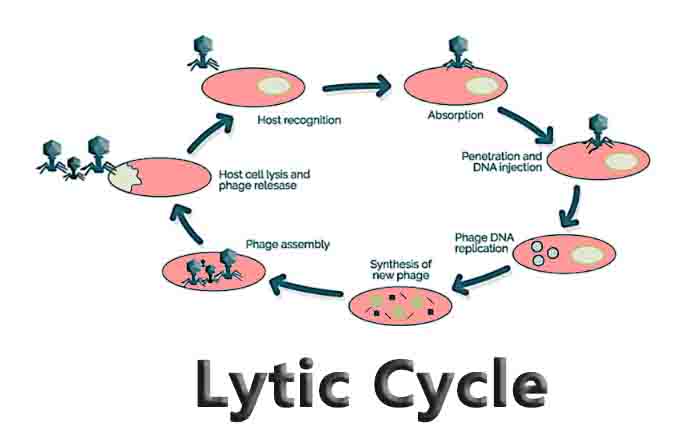
    Adsorption is the process through which a bacteria gets its DNA or RNA into the host cell. This is labeled as 1 in the image above. The capsid, or protein coat around the viral genome, consists of very specific proteins.

    This sheild of proteins not only comes together to protect the viral genes, it serves as a sort of “key” to unlock a cell. The surface of the proteins are shaped to interact with proteins on the surface of the host cell.

    When the “lock and key” align, the virion is bound to the cell membrane. When this happens, it also changes the shape of the capsid. This tears a hole or injects the viral DNA into the host cell. Here, it may travel into the nucleus or replicate in the cytoplasm. This depends on the virus itself, what type of genome it has, and the conditions of the cell.

    Replication

    During the lytic cycle, the replication of viral genes is carried out a number of times by a hijacked cellular system. Remember that the virus itself has imported few, if any, supporting proteins. Thus, the viral DNA must produce these in order to hijack the cell’s processes.

    The first proteins created are often created as the cell reads its own DNA and produces proteins. The viral genes simply sneak into the process. This creates what are called viral early proteins.

    These early proteins have important functions (to the virus) of commandeering the cell’s machinery. They clear the cell’s normal metabolic agenda, and turn many of its activities toward the replication of viral genes and the production of viral proteins. The virus uses the raw products the cell has assembled (amino acids and nucleic acids) as building blocks for the parts it needs.

    While this may seem like an overly complex process for such a small virus genome, consider first that there are really only a handful of proteins. Most viruses produce and code for only a handful of proteins.

    Unlike cells, a virus doesn’t need the complex proteins required to metabolize energy. As obligate parasites, a virus is dependent upon its host cell’s ability to provide raw materials. This makes it one of the most efficient forms of DNA replication that we know of.

    Assembly and Release

    As these parts are built, their natural evolutionary shapes help them come together in the proper way. Since most of the components are proteins, they have formed over evolutionary time to be able to come together with very little outside influence. The assembly of new virions is a hallmark of the lytic cycle. The other viral life cycle does not include producing and assembling new virions.

    In this way, the lytic cycle resembles a small virus factory. All of the parts of the virus are produced independently, then assembled, and finally released into the environment. While the image above shows only 3 assembled virions at stage 6, in reality there would be millions. Compare the lytic cycle to the lysogenic cycle below it, in which an accurate 2 copies are shown after 1 bacterial division.

    FAQ’s

    What is the lytic cycle?

    The lytic cycle is a process of viral replication in which a virus enters a host cell, hijacks the host’s cellular machinery to replicate its own genetic material, and ultimately causes the host cell to burst, releasing new viral particles that can infect other cells.

    How does the lytic cycle differ from the lysogenic cycle?

    The main difference between the lytic and lysogenic cycles is that in the lytic cycle, the viral DNA or RNA immediately takes over the host cell’s machinery and replicates itself, while in the lysogenic cycle, the viral DNA or RNA is integrated into the host cell’s DNA and may remain dormant for some time before activating.

    What are the stages of the lytic cycle?

    The lytic cycle consists of several stages, including attachment, penetration, biosynthesis, maturation, and release. During attachment, the virus attaches to a host cell. In penetration, the virus injects its genetic material into the host cell. In biosynthesis, the viral genetic material replicates, and new viral particles are produced. In maturation, the viral particles assemble and mature. In release, the host cell bursts, and new viral particles are released into the environment to infect other cells.

    What are some examples of viruses that use the lytic cycle?

    Some examples of viruses that use the lytic cycle include the influenza virus, the herpes simplex virus, and the human immunodeficiency virus (HIV).

    What is the significance of the lytic cycle in viral infections?

    The lytic cycle is a key mechanism by which viruses replicate and spread from host to host. Understanding the molecular mechanisms of the lytic cycle is important for developing treatments and vaccines to combat viral infections.
  • Synapomorphy

    Synapomorphy Definition

    A synapomorphy is a shared, derived character, common between an ancestor and its descendants. A character, or trait, is anything observable about the organism. It may be the size of the organism, the type of skin covering the organism has, or even things like eye color.

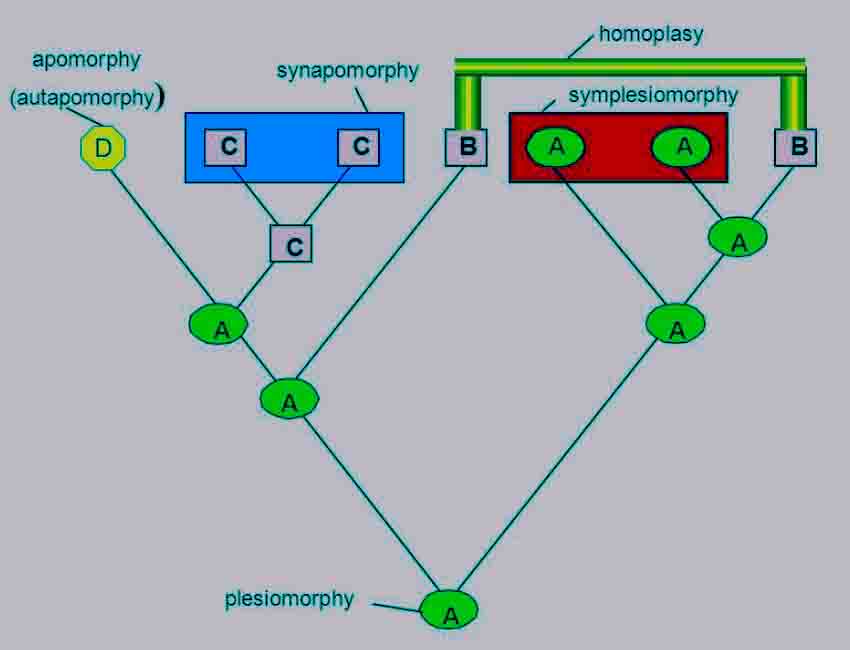
    A character may also be considered a specific sequence of DNA, which is how modern phylogenetic trees are constructed. As seen in the image below, a synapomorphy could be any characteristic shared by the descendants of a common ancestor.

    In fact, the term synapomorphy comes from the Greek “syn” meaning shared, “apo” meaning away from, and “morphe” meaning form or shape. In other words, the animals have a shared form as they move away from their ancestors and related animals.

    A synapomorphy can help scientists determine which groups of animals are related, and which aren’t. Animals which share a synapomorphy likely share a common ancestor. If groups of organisms share more than one synapomorphy, there is even more evidence that they are related.

    A synapomorphy is also known as a homology,

    Synapomorphy vs Apomorphy

    An apomorphy, as pictured in the image above, is a shared characteristic between two or more groups of organisms. An apomorphy becomes a synapomorphy when it is shown that the trait also belonged to a common ancestor. This last step must take place in the fossil record, and is often hypothetical because we can never truly know which animals reproduced to create the organisms we see today.

    A synapomorphy can reveal the relatedness of two species through its very presence. If a trait exists in two organisms, and is present in their most recent common ancestor, the trait can signal a clade. A clade is a term used when describing phylogenetic relationships. A clade denotes that all the organisms within the clade are related to a single common ancestor.

    Clades often contain many synapomorphies because the animals are so closely related. However, as organisms become new species they can develop new and unique characteristics. A novel trait is considered an autapomorphy.

    Synapomorphy vs Plesiomorphy

    In contrast to a synapomorphy, a plesiomorphy is a shared character, shared by two groups who inherited it from different ancestors. In the image above, the plesiomorphy identifies a character shared by two groups.

    Because the character (grayness) is not present in the darker organisms (black circles), the trait cannot be considered a synapomorphy. A synapomorphy says more about the relatedness of two species, because it indicates that the two organisms shared a common ancestor.

    Synapomorphy vs Homoplasy

    A homoplasy is the opposite of a homology, or synapomorphy. A synapomorphy implies that a homologous trait, one that is the same in both organisms, was inherited from the same ancestor. A homoplasy, on the other hand, is simply a trait that appeared in different organisms. This happens often in evolution, as different species evolve to accomplish the same tasks.

    Wings, for instance, have evolved a number of times. However, if one were to say the wings of birds and the wings of insects were a synapomorphy, that statement would be incorrect. Wings in birds and insects are a homoplasy, a trait which is similar but not from a common ancestor. Likewise, wings in birds and bats represent a homoplasy, not a synapomorphy because they were not inherited from the same organisms. Wings have evolved a number of times throughout evolution because the open air is a desirable niche which organisms can occupy.

    Examples of Synapomorphy

    Mammals

    Mammals share a synapomorphy of being able to produce milk. Milk is a nutritive substance which is excreted from the body and fed to the babies. While some people consider mammals to be furry animals with a placenta which give live birth, this definition excludes several obvious groups of mammals.

    The Monotremes, such as the platypus, still lay eggs but they feed their young milk which they excrete from glands. While their other features might make them seem more like birds or reptiles, milk production is a clear synapomorphy with the other mammals.

    The Marsupials represent another group of mammals which does not fully conform to other shared traits of mammals. The marsupials give live young, but raise their tiny, undeveloped offspring in a pouch until it is fully developed. More “typical” mammals have developed larger placentas and brown adipose tissue to sustain their babies and increase their development during gestation.

    Vertebrates

    All vertebrate animals share a single trait, the vertebrae. Vertebrae exist only within the Vertebrates, and are a synapomorphy of the subphylum. While all vertebrate organisms share this trait with a common ancestor, they differ in many other ways. In fact, the synapomorphy of having a vertebrae is just one clue that the animals are related.

    Other, related characteristics can obscure this relationship. For instance, the size, shape, and number of vertebrae can change depending on the organism.

    Some organisms, such as the terrestrial vertebrates, have more derived vertebrae which support limbs and the weight of the organism on land. The buoyancy of water alleviates the strain of gravity, which is why most fish vertebrae are made of cartilage or weak bones.

    Terrestrial vertebrates must have much more rigid bones to support the weight of gravity in air. This is one reason why marine animals tend to get much larger than terrestrial ones.

    FAQ’s

    What is Synapomorphy?

    Synapomorphy is a term used in evolutionary biology to describe a characteristic or trait that is shared by two or more species and their most recent common ancestor. These shared traits are used to infer evolutionary relationships between different groups of organisms.

    How is Synapomorphy identified?

    Synapomorphies are identified through phylogenetic analysis, which involves comparing the physical and genetic characteristics of different organisms to determine their evolutionary relationships. Shared traits that are present in all members of a group but absent in other groups are considered synapomorphies.

    What is the significance of Synapomorphy?

    Synapomorphies are important because they provide evidence for common ancestry and help to establish the evolutionary relationships between different groups of organisms. They are also used to develop hypotheses about the timing and pattern of evolutionary events, such as when different groups of organisms diverged from each other.

    Can Synapomorphy be used to identify new species?

    Yes, Synapomorphy can be used to identify new species. By comparing the physical and genetic characteristics of different individuals, researchers can determine whether they share unique traits that are not present in other species. If a group of individuals share a unique set of synapomorphies, they may be classified as a new species.

    How does Synapomorphy differ from Homoplasy?

    Synapomorphy differs from homoplasy, which is the independent evolution of similar traits in different groups of organisms. Homoplasy can be caused by convergent evolution, parallel evolution, or reversal, and can often be mistaken for synapomorphy. However, synapomorphies are shared traits that are present in all members of a group and their most recent common ancestor, while homoplasies are similar traits that are not the result of shared ancestry.